
- Bar / Barrier Seals
- Bolt Seals
- Cable Seals
- Pull Tight Cable Seal 17″ (5/64″ / 1.8mm) PTSEAL (17″)
- Pull Tight Cable Seal 39″ (5/64″ / 1.8mm) PTSEAL (39″)
- Pull Tight Cable Seal – Model JoeGuard Series 12″
- Pull Tight Cable Seal – Model JoeGuard Series 39″
- Pull Tight Cable Seal – Model JoeGuard Series 58″
- Pull Tight Cable Seal – Model JoeGuard 78″
- Plastic Seals
- Tin Seals
- Meter Seals
- Tamper-Proof Labels
- Trailer Seals


ISO 17712 Cable Seal Requirements: What Makes a Cable Seal “High Security”

High-Security Seal Standards
A practical guide to the ISO 17712:2013 requirements for cable seals — the tests, the tamper-evidence rules, the manufacturer audits, and how to verify a supplier is actually compliant.
By American Seals | Updated May 29, 2026 | 10 min read
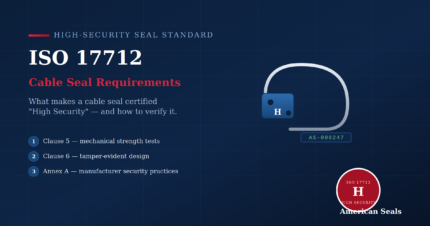
ISO 17712:2013 defines what qualifies a cable seal as “H” — the high-security class required by C-TPAT and most international freight programs.
If your cable seals are securing containers moving in international commerce, one specification decides whether U.S. Customs will accept them at the border: ISO 17712. This international standard sets uniform requirements for mechanical freight container seals — and its “H” (High Security) class is what C-TPAT, CBP, and virtually every serious supply-chain security program demand.
Understanding what actually goes into an ISO 17712 cable seal certification protects you from three real risks: buying seals that look compliant but aren’t, having shipments held for inspection because the seal spec is wrong, and losing C-TPAT standing after an audit. This guide breaks down the standard the way a procurement or logistics lead needs to see it — the tests, the paperwork, the cable specs, and how to verify a supplier isn’t just claiming compliance.
ISO 17712 Cable Seal Requirements — At a Glance
| Current standard | ISO 17712:2013 (still current, formerly known as ISO/PAS 17712) |
| Class required by C-TPAT | “H” — High Security |
| Physical tests (Clause 5) | Tensile, shear, bending, impact (room + reduced temperature) |
| Tamper evidence (Clause 6) | Design must produce visible tell-tale signs of tampering |
| Manufacturer (Annex A) | ISO 9001 certified with documented security practices |
| Testing lab | Independent, ISO/IEC 17025 accredited — never self-certified |
What Is ISO 17712 and Why Cable Seals Have to Meet It
ISO 17712 is the international standard that establishes uniform procedures for the classification, acceptance, and withdrawal of mechanical freight container seals. Published in its current form in 2013, it replaced the earlier Publicly Available Specification (which is why you still see the standard referenced as “ISO/PAS 17712” in many documents and product listings).
The standard defines three seal classes by barrier capacity:
“I” — Indicative: Lightweight seals that show tampering but offer minimal physical barrier. Think plastic pull-tights for low-value or short-haul applications. “S” — Security: A middle tier with more mechanical strength than indicative seals. “H” — High Security: The top class — the only one accepted for C-TPAT-compliant international container shipments into the United States. If a cable seal is going on an ocean container, this is the class it needs.
For a deeper look at why ISO 17712 exists and how it fits into global supply-chain security, see our companion article: Importance of ISO PAS 17712:2013 in Security Seals for International Trade.
The Three Pillars of ISO 17712 Compliance
Compliance is not a single test. To carry the “H” designation, a cable seal — and the company that makes it — must satisfy three separate requirements, each independently verified by a different type of accredited body.
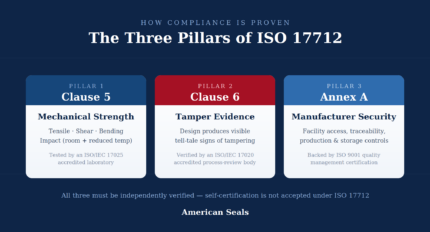
All three pillars must be verified independently. Self-certification is not accepted.
Pillar 1 — Clause 5: Mechanical Strength
The seal’s physical resistance to attack, verified by an ISO/IEC 17025 accredited laboratory. This is the destructive-testing portion of the standard, and it’s where the “H” class thresholds are enforced.
Pillar 2 — Clause 6: Tamper Evidence
The seal must be designed and constructed so that tampering produces visible tell-tale evidence — cut marks, deformation, broken locking mechanisms, or missing components that a trained inspector can spot at a glance. Compliance is confirmed by a process-review body accredited to ISO/IEC 17020.
Pillar 3 — Annex A: Manufacturer Security Practices
The standard extends to the factory itself. Annex A defines more than two dozen required practices covering facility risk assessments, access controls to production and storage areas, raw material traceability, batch documentation, and secure numbering. The manufacturer must hold ISO 9001 certification and pass an Annex A audit — otherwise the ISO 17712:2013 claim on the seal is not valid, no matter how well the seal performs in the lab.
Clause 5 in Detail: The Four Physical Tests
The mechanical testing under Clause 5 is where most people focus, because it’s the most tangible part of the standard. For a cable seal to earn the “H” rating, it has to pass four distinct tests, each at the highest severity threshold.
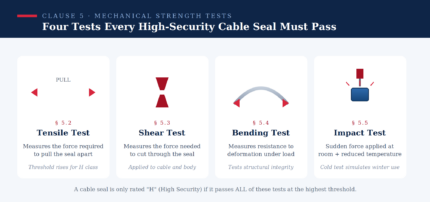
Every H-class cable seal must pass all four tests at the highest threshold.
§ 5.2 — Tensile Test
The seal is pulled apart in a universal testing machine to measure the force required to break it. For cable seals, this is applied along the axis of the cable itself — simulating the most obvious attack: yanking on the seal to try to force it open.
§ 5.3 — Shear Test
A controlled cutting force is applied across the cable and seal body. This test simulates a bolt cutter or hand shear being used to defeat the seal. The H threshold is high enough that ordinary hand tools cannot pass it — a would-be thief would need heavy equipment that is difficult to conceal.
§ 5.4 — Bending Test
The seal body is bent under load to test how it resists deformation. Cheap seal housings can be pried or bent to expose the locking mechanism — a compliant H-class design resists this even under significant torque.
§ 5.5 — Impact Test (Room Temperature and Reduced Temperature)
A drop-weight impact is applied to the seal body. This is done twice — once at room temperature, and once at reduced temperature to simulate winter shipping conditions in northern climates. Many otherwise strong seals become brittle when cold, so the low-temperature test is critical for seals used on trans-oceanic and northern rail routes.
Cable Diameter and Material Requirements
ISO 17712 does not prescribe a single cable diameter, but the physical test thresholds effectively require a certain minimum. In practice, cable seals rated “H” typically use a galvanized steel cable of approximately 3 mm or larger. Below that, the tensile and shear thresholds cannot be met.
This matters because there is a large market of pull-tight cable seals with thinner cables (1.8 mm and similar) — sometimes marketed with references to “ISO PAS” or “17712” without specifying that they qualify only under the lower “S” or “I” classes. Those seals are useful for domestic trailers, meter security, and utility applications, but they should not be used on ISO containers subject to C-TPAT rules.
Important: Our lighter PTSeal cable seals (1.8 mm cable) are excellent for domestic trailers, meter enclosures, and utility applications — but they are not H-class. For international container shipments requiring ISO 17712 High Security compliance, use the JoeGuard series linked below.
Marking and Identification Requirements
The standard requires every high-security seal to carry:
The “H” designation — permanently marked on the seal body to identify the class. A unique alphanumeric identifier — no two seals may share a number within the manufacturer’s production. Manufacturer identification — a mark or logo that traces the seal to its producer. Optional customer marking — company name or logo, applied by the manufacturer as part of the controlled production process (not applied after the fact by the end user).
Numbering must be laser-engraved or stamped into the body, not printed, so it cannot be altered or duplicated. All American Seals JoeGuard cable seals include consecutive numbering with barcoded serial numbers as standard, and company-name engraving is free at qualifying volumes.
How to Verify a Supplier’s ISO 17712 Compliance
“ISO 17712 compliant” printed on a box is not proof of anything. Before purchasing cable seals for a compliance-critical application, ask the supplier for these documents:
1. The independent lab test certificate. Issued by an ISO/IEC 17025 accredited laboratory, naming the specific seal model and confirming a PASS rating on § 5.2, § 5.3, § 5.4, and § 5.5 (both temperature conditions). 2. The manufacturer’s ISO 9001 certificate. This confirms the quality management system behind production. 3. The ISO 17712 Annex A compliance letter or certificate. Issued by a process-review body accredited to ISO/IEC 17020. 4. The Clause 6 tamper-evidence letter. Sometimes combined with the Annex A document. 5. A conformance statement tying all of the above to the specific SKU you are buying.
If a supplier cannot produce these on request, treat the compliance claim as unverified.
Common Mistakes We See
Assuming any “cable seal” is high security. Cable diameter and construction determine the class — a 1.8 mm pull-tight is not the same product as a 3+ mm H-class seal. Reusing seal numbers across shipments. Uniqueness is required by the standard; recycling numbers voids the audit trail. Skipping the Annex A verification. A seal can pass lab tests and still be non-compliant if the factory is not audited. Confusing “ISO PAS 17712” and “ISO 17712” as different standards. They aren’t — the “PAS” (Publicly Available Specification) was the earlier development stage; the 2013 revision is the current published standard.
JoeGuard Cable Seals — ISO 17712:2013 Compliant
American Seals’ JoeGuard cable seal series is manufactured to ISO 17712:2013 High Security requirements, with consecutive numbering, laser-engraved company name at qualifying volumes, and available in 12″, 39″, 58″ and 78″ lengths.
American Seals Cable Seal Product Range
| Product | Length | ISO 17712 Class | Typical Use |
|---|---|---|---|
| JoeGuard 12″ | 12 in / 305 mm | “H” High Security | Short-hasp containers, valves, meters |
| JoeGuard 39″ | 39 in / 990 mm | “H” High Security | Standard containers, trailers, railcars |
| JoeGuard 58″ | 58 in / 1,473 mm | “H” High Security | Wide-hasp containers, complex latches |
| JoeGuard 78″ | 78 in / 1,981 mm | “H” High Security | Oversized doors, valve trains, tank hatches |
| PTSeal 14″/39″ | 14 in – 39 in | Indicative / Security class | Domestic trailers, meters, utilities |
Considering a bolt seal instead of, or in addition to, a cable seal? See our QueenSeal Bolt Seal (also ISO 17712 “H” class) and Seaforce®1 Bar Seals. And for the customs paperwork side, our HS Code 8309.90.0000 guide covers how these products are classified for import and export.
Frequently Asked Questions
Is ISO 17712 the same as ISO PAS 17712?
Yes. “PAS” stands for “Publicly Available Specification,” which was the standard’s earlier development stage. The 2013 revision is the current published ISO standard, but both terms are still used in industry — you will see product listings and certificates referencing either “ISO 17712:2013” or “ISO PAS 17712:2013” and they refer to the same standard.
Does C-TPAT require ISO 17712 cable seals?
Yes. C-TPAT (Customs-Trade Partnership Against Terrorism) requires that seals used on containers entering the U.S. as part of the program meet ISO 17712 “H” (High Security) class. Cable seals rated “I” or “S” do not qualify.
How do I know a cable seal is actually H-class and not just labeled that way?
Ask the supplier for the independent laboratory test certificate (issued by an ISO/IEC 17025 accredited lab), the manufacturer’s ISO 9001 certificate, and the Annex A / Clause 6 compliance letters. If those documents aren’t available for the specific SKU, treat the claim as unverified.
Can I laser-engrave my company name on ISO 17712 cable seals?
Yes — as long as the engraving is done by the manufacturer as part of the controlled production process (which preserves the audit trail and unique-ID requirements), not applied after purchase by the end user. American Seals offers free company-name laser engraving on JoeGuard cable seals at qualifying volumes.
What’s the difference between a cable seal and a bolt seal for ISO 17712?
Both can be certified to “H” class if properly designed and tested. The main functional difference is that cable seals are flexible and adjustable (the cable pulls tight against whatever hasp shape they secure), while bolt seals use a rigid steel pin and are typically simpler to inspect. Many operators use both — bolt seals on primary container doors and cable seals on valves, secondary hatches, and non-standard latches.
Are your JoeGuard cable seals ISO 17712 certified?
Yes. Our JoeGuard series is manufactured to ISO 17712:2013 High Security (“H”) requirements, with independent lab testing and Annex A compliance documentation available on request.
Related Reading
» Importance of ISO PAS 17712:2013 in Security Seals for International Trade
» HS Code 8309.90.0000 Explained: Customs Classification for Metal Security Seals
» How to Apply Bolt, Cable, and Bar Seals
Disclaimer: This article is for general informational purposes only and does not constitute compliance, legal, or customs advice. ISO 17712, C-TPAT, and related programs are updated periodically. Always verify current requirements with the relevant certifying body, U.S. Customs and Border Protection, or a qualified compliance advisor before making procurement decisions.